30
Nov
Sometimes it also called as distributive law of multiplication and division. 310 2 312 36.
What is the distributive property of multiplication over addition. Distributive property of multiplication over addition is a very useful property that lets us simplify expressions in which we are multiplying a number by the sum of two or more other numbers. The property states that the product of a number and the sum of two or more other numbers is equal to the sum of the products. Distributive Property of Multiplication Over Addition.
The distributive property of multiplication over addition is applied when you multiply a value by a sum. For example you want to multiply 5 by the sum of 10 3. As we have like terms we usually first add the numbers and then multiply by 5.
510 3 513 65. But according to the property you can first multiply every addend by 5. The distributive property of multiplication over addition can be used when you multiply a number by a sum.
For example suppose you want to multiply 3 by the sum of 10 2. 310 2. According to this property you can add the numbers and then multiply by 3.
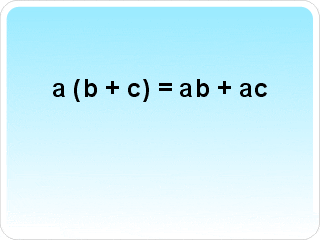
310 2 312 36. Or you can first multiply each addend by the 3. A b c a b a c An arithmetic property that distributes the multiplication across the addition is called the distributive property of multiplication over addition.
In rings by definition multiplication does distribute over addition and also addition and multiplication are associative and addition is commutative. And the fact that multiplication is associative lets us define an exponentiation operation at least with nonnegative integer exponents thats distributive in the sense that A x y A x A y. The Distributive property of Multiplication over Addition.
You just multiply the number on the outside of the parentheses by EVERYTHING inside the parentheses. 26 3 2 3 4 32 3 3 34 Lets check. Do YOU think thats true.
You out there reading this. 27 3 2 3 4 32 3 3 34 You mean. 39 6 9 12.
15 12 27 Right. Distributivity of multiplication over addition is true -in real numbers-. If everything is kept the same those numbers for which addition distributes over multiplication turn out to be a subset of the reals as others noted if a b c a b a c then either a 0 or a b c 1.
The distributive property is. Abc ab ac. The number outside the parenthesis gets distributed to the numbers inside the parenthesis.
We can easily verify that this is true using some numbers instead of letters. If the distributive property is true then it must work in this sentence. 53 6 53 56.
53 6 59 45. The different properties are associative property commutative property distributive property inverse property identity property and so on. The distributive property is the one which allows us to multiply the number by a group of numbers which are added.
The distributive property of multiplication over addition can be used when you multiply a number by a sum. For example suppose you want to multiply 3 by the sum of 10 2. According to this property you can add the numbers and then multiply by 3.
310 2 312 36. The distributive law is symbolically represented as a bc ab ac. When the values of a b and c are entered in the distributive property of multiplication over addition calculator it.
Distributive Property of Multiplication. It is the multiplication of number by addition or subtraction equal to the sum or difference of the products. With distributive property you can solve the expression in the form of a bc.
Sometimes it also called as distributive law of multiplication and division. The distributive property is involving multiplying over grouped subtraction or addition terms. It is stating that we are multiplying the number thats outside of the parentheses by each term thats inside of the parentheses and then add or subtract just as in the original.
The distributive property in multiplication is a useful property. The distributive property of multiplication over subtraction is the same as the distributive property of multiplication over addition. You might subtract the numbers and then multiply or you might multiply and then subtract.
This is known as distributing the multiplier. Distributive property is one of the fundamental properties of numbers and basic operations of Mathematics. This property refers to the distribution of multiplication over addition or subtraction.
Hence it is most popularly known as the distributive property of multiplication over addition or subtraction. Distributive Property of Multiplication over Addition and Mulitplication. What is distributive property of mutiplication over addition or subtraction.
This is sometimes just called the distributive law or the distribut. Learn how to apply the distributive law of multiplication over addition and why it works. The distributive property is an acceptable way of eliminating parentheses provided the parentheses contain only additionsubtraction and you have a value to be multiplied with the parentheses.
In that situation there is no conflictviolation of the order of operations rules. You are eliminating the parenthese by doing the distribution.